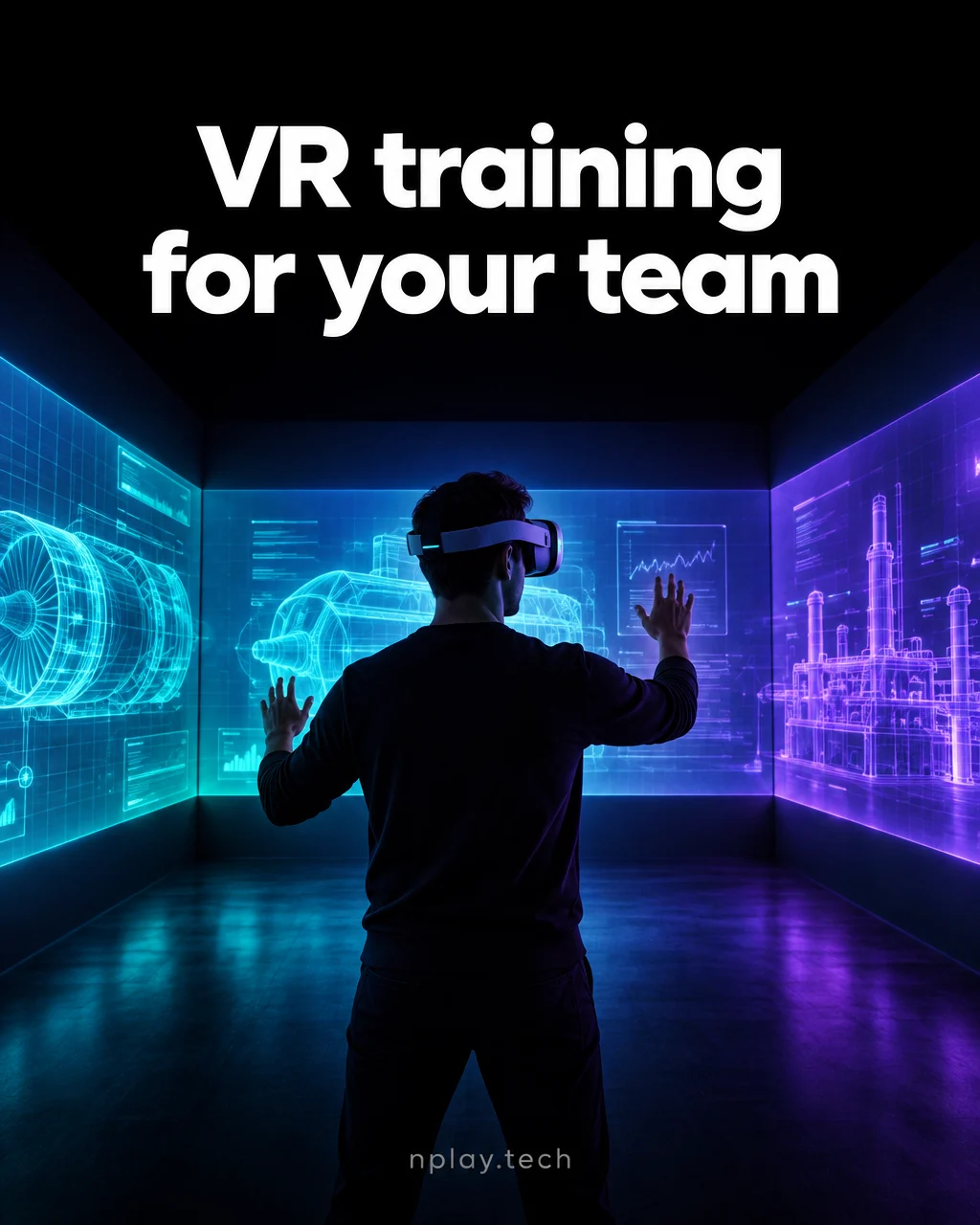
Train employees in a risk-free virtual environment. Nplay builds VR training simulation programs that let teams practice dangerous, expensive or rare scenarios — factory floors, emergency response, equipment operation — safely, repeatably and with measurable results.
Machine operation, assembly lines and maintenance procedures simulated to your exact equipment.
Fire, evacuation and hazard scenarios that are too dangerous to rehearse in real life.
Built-in scoring and analytics: every trainee's decisions, timing and errors are measured.
Trainer-led group sessions with live monitoring and replay.
Voice-over, interface and scenarios native in both languages.
Headset supply, training-room setup and train-the-trainer programs.
01. Vision — turning ideas into clear, actionable concepts.
02. Build — designing and developing the core solution.
03. Engage — smart technologies that attract and retain users.
04. Grow — measurement, iteration and market expansion.
Trainees learn by doing, not watching. Studies and our client results show higher retention, faster onboarding and zero risk — mistakes happen in the simulator, not on the factory floor.
Yes. We build digital twins of your actual equipment, lines and facilities, so the training matches reality one-to-one.
Typically standalone VR headsets (no PC required) which we supply and configure, plus an optional trainer dashboard on a laptop or screen.
Talk to our team — we answer in Arabic, English and Chinese.
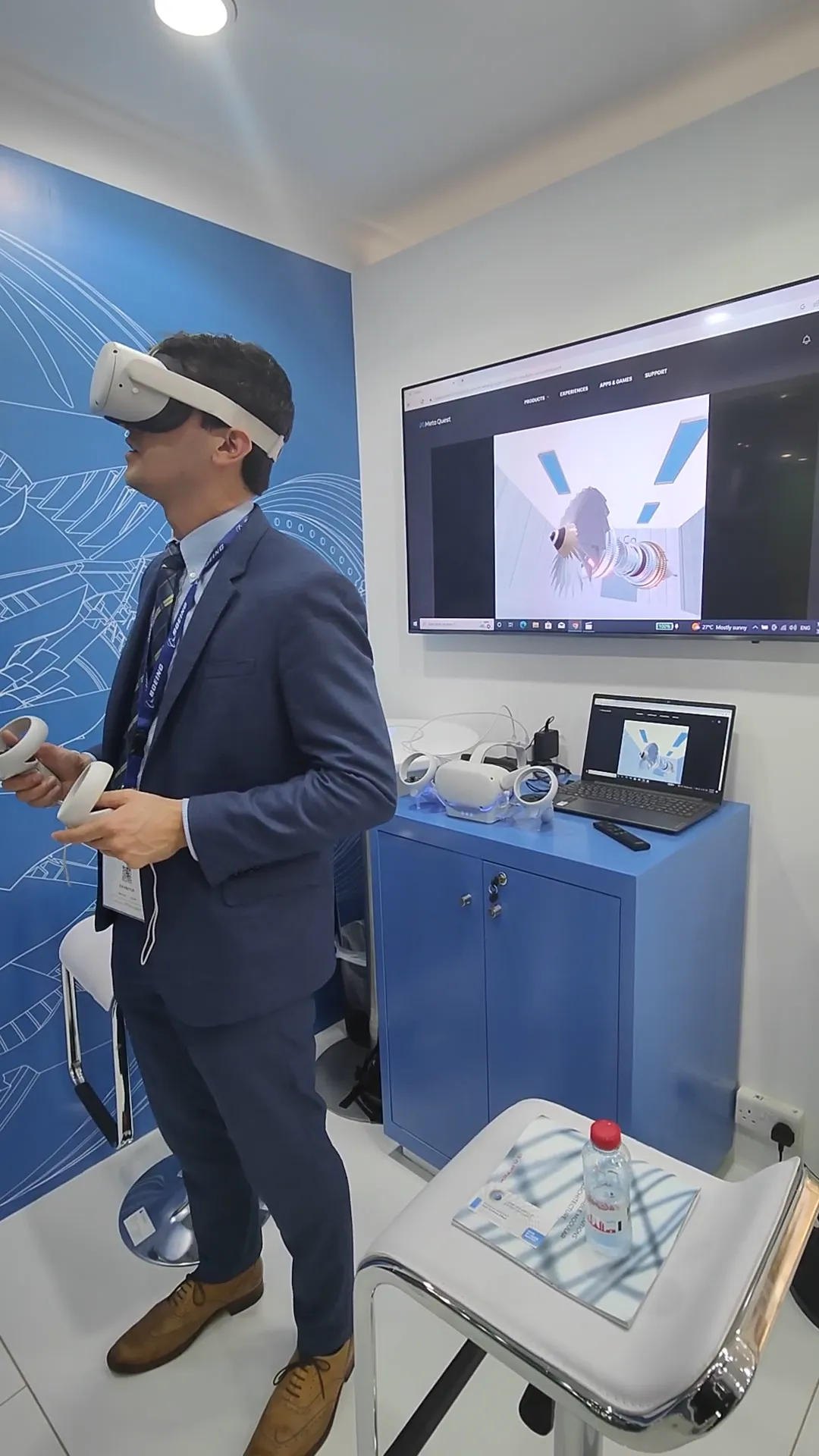
Start Your Project All ServicesVR training puts your team inside a realistic scenario where they can practise, make mistakes and repeat, without risk to people, equipment or customers. These frames are from VR demos our team ran at an exhibition stand and in an office session.
| Classroom | Video | VR training | |
|---|---|---|---|
| Hands-on practice | Limited | None | Yes, repeatable |
| Safe to make mistakes | Sometimes | n/a | Yes |
| Same quality every time | Depends on trainer | Yes | Yes |
| Measures performance | Tests only | Views only | Every action and decision |
| Needs the real site or machine | Often | No | No |
It does not replace every course. It works best for skills that are dangerous, expensive, rare or hard to practise on the job, and it often sits next to classroom sessions.
One of the strongest reasons to choose virtual practice is data. Every session can record what the trainee did, in what order and how long it took. Managers can see who is ready, who needs another session, and which steps most people get wrong. That last point is often the most useful: it shows where procedures or classroom training need to improve.
Most immersive courses today run on standalone headsets that do not need a computer or cables. They are light, quick to set up, and can be carried between sites. For complex simulations we can use PC-powered headsets. We help you choose the right devices, prepare them, and set up a simple way to update training content without visiting every site.
The trainee hears an alarm, finds the nearest extinguisher, checks the type, and approaches the fire from the right direction. If they pick the wrong extinguisher or block the exit, the scenario shows what happens and explains why. At the end, the trainee sees a score for speed, correct steps and safety. Supervisors see the same report for every person who completed it.
A virtual customer arrives upset about a delayed order, speaking in Jordanian or Saudi Arabic. The trainee chooses how to respond, and the customer reacts to each choice. Calm, clear answers lower the tension; defensive answers raise it. This kind of practice is hard to do in a classroom, because role-play with colleagues rarely feels real.
New operators practise the exact sequence for starting and stopping a machine: checks, guards, switches and confirmations. They can repeat it ten times in a morning without stopping production, and the system flags any missed step. When they move to the real machine, the routine already feels familiar.
Not everyone has used a headset before. We keep first sessions short, start with a simple tutorial room, and avoid fast artificial movement that can cause discomfort. Scenarios can be completed standing or seated, and trainers can watch the headset view on a screen to guide people who need help. For trainees who wear glasses, we choose headsets with enough space or spacers.
Procedures change, equipment is replaced, and new risks appear. We build modules so that text, voice, steps and scoring rules can be updated without rebuilding the whole scenario. New versions can be pushed to all headsets from one place. This keeps the investment useful for years, not only for the first group of trainees.
The best results come when three people are involved: a training or HR lead who owns the goals, a subject expert who knows the real procedure, and an IT contact who helps with devices and network access. We handle design, 3D, development and testing, and keep each of them involved at the right moments, so the final module matches how work is really done on your site.
We usually recommend starting with one scenario and one group. Build it, run it with 20 to 30 trainees, compare their results with your current method, and decide from real data whether to expand. This keeps the first investment controlled and gives management clear evidence.
Nplay has built immersive VR and interactive experiences since 2017, from our headquarters in Amman, with an office in Riyadh and a production team in Cairo. If you are planning immersive training in Jordan or Saudi Arabia, we can help you choose the first scenario that will show value fastest.
Yes. Instructions, voice guidance and feedback can be in Arabic, English or both.
Some people feel discomfort in their first sessions. We design movement carefully, keep sessions short at first, and let trainees sit when needed.
Yes, from photos, drawings, CAD files or site visits.
Yes. Our Riyadh office supports clients across the Kingdom, with the same team that builds the modules.
Most scenarios take 10 to 20 minutes. Short sessions keep attention high and let a trainer run a full group through VR training in one morning, with time for a short debrief after each person finishes. We can also split longer procedures into several short modules that build on each other.
Pick one skill your team needs to practise. We reply with how a VR scenario could teach it.
WhatsApp usRequest a demo